
There is a particular kind of silence that settles in the days after someone dies. It isn’t empty or cold; it has a weight to it, like a room holding its breath. Families often move through those early days as though they’re slightly out of step with the rest of the world, making decisions, calling relatives, choosing flowers, while inside everything feels strangely unreal.
I remember sitting with a family not long ago, a daughter who kept wringing her hands as she spoke. “I know Mum’s gone,” she kept saying. “But part of me still thinks she’s just in the next room.” She wasn’t the first to say something like this and she won’t be the last. When someone you love dies, the heart often lags behind the facts.
Later that afternoon, when she stood beside her mother for the first time since the death, something in her shifted. Her shoulders dropped, her breathing softened. She reached out and placed her hand on her mother’s and for the first time all week, she was completely present.
“It’s real now,” she whispered. “But it’s peaceful.”
That moment, quiet, gentle, almost sacred, is why seeing someone one last time matters.
A final viewing isn’t about ceremony or tradition, it’s about connection. It’s about allowing the reality of the loss to land in a way that isn’t jarring or rushed. When people don’t have that moment, many describe feeling suspended, as if part of the story hasn’t been told yet. The mind continues to hope, to imagine, to replay those last conversations. Without meaning to, we keep waiting for an update that will never come.
Being with someone in that stillness brings the truth into focus, but softly. You see the person you love cared for, prepared and at peace. For many, that replaces the harder memories, the last night in hospital, the confusion, the distress – with something gentler. You begin to remember not the moment of death, but the person themselves.
Some people come with words ready, things they didn’t get the chance to say. Others bring small offerings: a newspaper folded to the crossword they always did, a sprig of rosemary, a favourite scarf. Some sit quietly and let the memories move through them. There is no right way to be there, just your way.
I once watched a young man stand beside his father, unable to speak. He just stood there, hands in his pockets, breathing in slow, careful breaths. After a while he nodded, just once, as if acknowledging something only he could hear. When he turned to leave, he said, almost apologetically, “I didn’t say anything.” His sister touched his arm and replied, “You didn’t need to.”
And that is the truth of these moments. They aren’t about performance or perfect words, they are about giving yourself permission to be with the reality of the loss, without rush, without pressure and without an audience.
For some, the idea of viewing feels daunting at first. They worry it will be too hard or too confronting. But very often, the moment itself is far gentler than the anticipation. A calm room, soft lighting, someone you love resting peacefully. It doesn’t remove the grief, but it does help shape it into something you can begin to carry.
What families tell us afterwards is rarely dramatic. More often, it’s simple. “I’m glad I went.” “It helped.” “It gave me peace.” These are quiet blessings, but they matter. They become the foundation on which the rest of the grieving process is built.
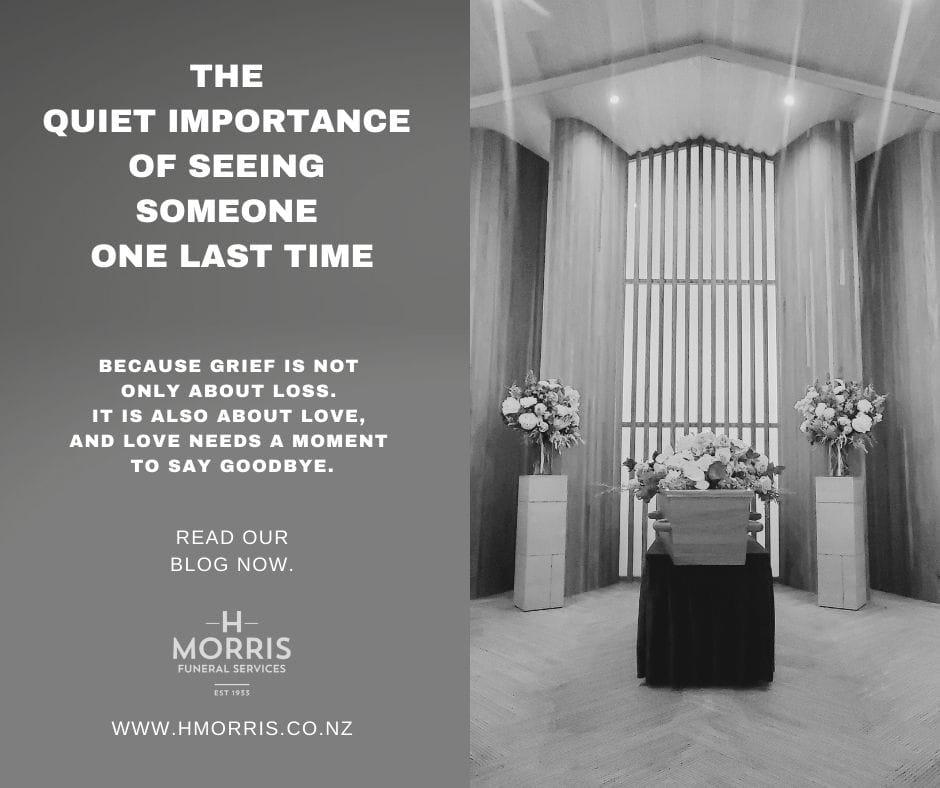
Because grief is not only about loss. It is also about love, and love needs a moment to say goodbye.
When the time comes for burial or cremation, the day moves quickly. People arrive, music plays, tributes are read, hands are shaken. A viewing, by contrast, is slow, unhurried, it’s personal. It gives you space before the world steps back in.
And long after the flowers have faded and the sympathy cards have been tucked away, that final moment, your moment – remains. A last look. A last touch. A last act of presence.
Not everyone chooses to view their loved one, and that is okay. But for those who do, it is often one of the most healing parts of the journey. A tender pause before goodbye, and a gentle beginning to the long, loving work of remembering.




Let us help you
We are always on hand to answer any questions you might have. We know what we are doing, and we’re here to look after you. Call or email us, we will guide you and liaise with the authorities on your behalf.
